Your formula was working perfectly. Then you copied it to another cell — and everything broke. Sound familiar? This happens because Excel doesn’t know which part of your formula should stay fixed. That’s exactly where a mixed cell reference in Excel saves you.
In this guide, you’ll learn what mixed references are, how they work, and how to use them in real situations — with step-by-step examples. Whether you’re a student, an office professional, or just someone who uses Excel daily, this is one skill you’ll use forever.
📋 Table of Contents
- What Is a Mixed Cell Reference in Excel?
- The Dollar Sign ($) — What Does It Actually Do?
- $A1 vs A$1 — What’s the Difference?
- How to Create a Mixed Cell Reference in Excel
- Using the F4 Key Shortcut
- Mixed Cell Reference Examples in Excel
- Relative vs Absolute vs Mixed — Full Comparison Table
- Mixed Cell Reference in Google Sheets
- Common Mistakes to Avoid
- FAQ
- Conclusion
🎯 What Is a Mixed Cell Reference in Excel?
In Excel, every formula uses cell references — like A1, B3, or C10. These tell Excel where to get the data.
There are three types of cell references:
- ✅ Relative Reference — changes when you copy the formula (e.g.,
A1) - ✅ Absolute Reference — stays fixed no matter where you copy (e.g.,
$A$1) - ✅ Mixed Cell Reference — locks only one part — either the row or the column (e.g.,
$A1orA$1)
A mixed cell reference in Excel is the sweet spot between relative and absolute. It gives you partial control — which is exactly what you need for complex formulas.
🔥 Quick Summary: Mixed reference = lock the row OR the column, not both. This lets your formula copy correctly across rows and columns at the same time.
💡 The Dollar Sign ($) — What Does It Actually Do?
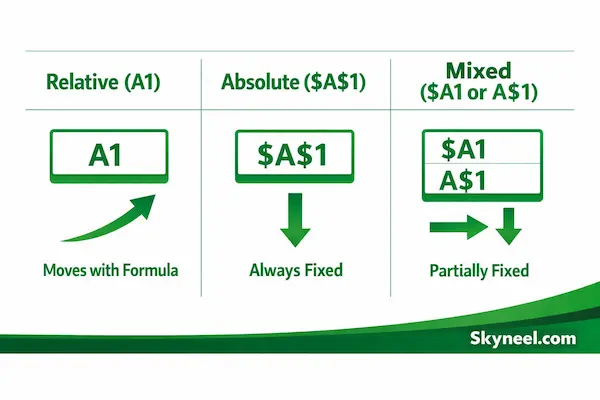
The dollar sign ($) in an Excel formula is like a padlock. It locks the part it sits in front of.
Here’s how it works:
- 📌
$A1— the column A is locked, but the row number can change - 📌
A$1— the row 1 is locked, but the column letter can change - 📌
$A$1— both row and column are locked (this is an absolute reference) - 📌
A1— nothing is locked (this is a relative reference)
So when you see one dollar sign in a cell reference — either before the column letter or before the row number — that’s a mixed reference.
Without the dollar sign, Excel assumes you’re using a relative reference. That means when you copy the formula to another cell, Excel automatically adjusts every cell address. Most of the time, that’s helpful. But sometimes you need one part to stay fixed — and that’s when you reach for the dollar sign.
Think of it this way: you have a formula =A1*B1 in cell C1. If you copy it to C2, Excel automatically changes it to =A2*B2. That’s relative behavior. Now if your formula is =A1*B$1 and you copy it to C2, it becomes =A2*B$1 — the B column updates, but row 1 stays locked because of the dollar sign.
💡 Pro Tip: Think of the $ sign as saying “stay here!” to that part of the address. One $ = partial lock. Two $$ = full lock.
📊 $A1 vs A$1 — What’s the Difference?
This is where most people get confused. Let’s clear it up right now.
$A1 — Column is locked, row is free
When you copy this formula across columns (left to right), the column stays on A. But when you copy it down rows, the row number updates automatically.
Use this when: you want to pull data from a fixed column while copying the formula down.
A$1 — Row is locked, column is free
This is how to lock row but not column in Excel formula. When you copy the formula down rows, it always points back to row 1. But copying it across columns updates the column letter.
Use this when: you want to pull data from a fixed row while copying the formula across.
✅ Key Takeaway: The $ locks whichever part it’s in front of. $A = column locked. $1 = row locked. Simple as that.
⚙️ How to Create a Mixed Cell Reference in Excel
You can create a mixed reference in two ways. The shortcut method is much faster.
But before you start, here’s a quick mental checklist to use every time:
- 👉 Am I copying the formula down (row by row)? → Lock the row → use
A$1 - 👉 Am I copying the formula across (column by column)? → Lock the column → use
$A1 - 👉 Am I copying in both directions? → You’ll likely need both types in the same formula, like
=$B2*C$1
Once you know which direction you’re copying, creating the reference takes just a second.
🚀 Method 1: Using the F4 Key Shortcut (Fastest Method)
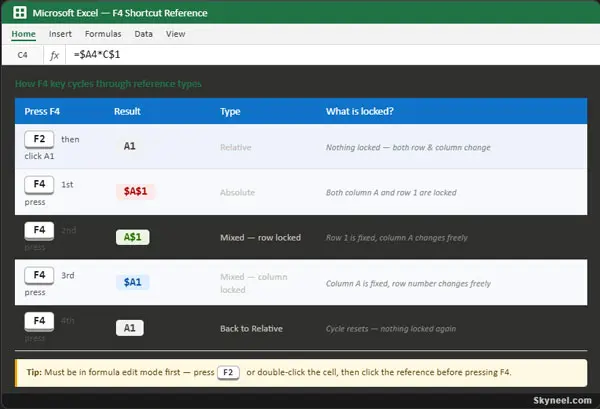
The F4 key is your best friend here. It cycles through all four reference types in order.
Here’s exactly how it works:
- Click on the cell with your formula
- In the formula bar, click on the cell reference you want to change (e.g., click on
A1) - Press F4 once — it becomes
$A$1(absolute) - Press F4 again — it becomes
A$1(row locked) - Press F4 again — it becomes
$A1(column locked) - Press F4 once more — it goes back to
A1(relative)
💡 Pro Tip: You must be in formula edit mode (press F2 or double-click the cell) before pressing F4. Otherwise F4 repeats your last action instead.
📝 Method 2: Typing It Manually
You can also type the dollar sign directly into the formula bar.
- Select your cell and open the formula
- Find the cell reference you want to change
- Type
$before the column letter, the row number, or both - Press Enter to confirm
For example, change =A1*B1 to =$A1*B1 by simply adding a dollar sign before A.
📊 Mixed Cell Reference Examples in Excel (Real Use Cases)
Let’s go beyond theory. Here are three real-world examples where mixed references make your life much easier.
Example 1 — Multiplication Table
Want to build a complete multiplication table in Excel with just one formula? Mixed references make it possible.
Set up your sheet like this:
- Row 1 (B1 to J1): numbers 1 through 9
- Column A (A2 to A10): numbers 1 through 9
Now in cell B2, enter this formula:
=B$1*$A2
Here’s what’s happening:
B$1— row 1 is locked, so it always picks the number from row 1 as you copy down$A2— column A is locked, so it always picks the number from column A as you copy across
Copy this single formula across the entire table — and your full multiplication table fills in perfectly. That’s the beauty of mixed cell references.
🔥 Quick Summary: One formula. One copy. Entire multiplication table done. Mixed references made that possible.
Example 2 — Sales Commission Calculator
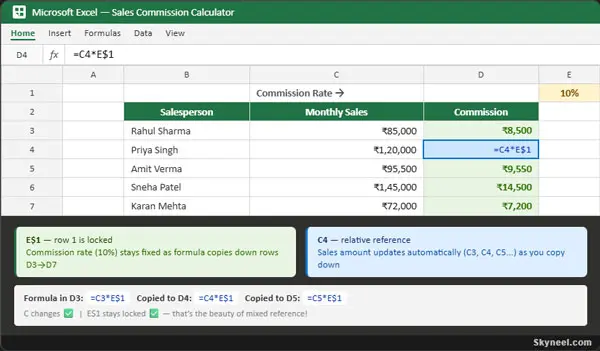
Imagine you have a sales sheet. Column B has salesperson names. Column C has their monthly sales amounts. Your commission rate (10%) is stored in cell E1.
You want to calculate commission for each salesperson. In cell D2, you’d normally write:
=C2*E1
However, when you copy this formula down, E1 shifts to E2, E3, and so on — which gives wrong results.
The fix? Use a mixed reference:
=C2*E$1
Now the row 1 is locked. As you copy the formula down, C2 updates to C3, C4 etc. — but E$1 always stays on row 1. Your commission rate never shifts.
⚠️ Warning: If you use a fully absolute reference like
$E$1here, the formula will still work for this case. But mixed references become essential when you need the formula to copy correctly in two directions — both across and down.
Example 3 — Tax Calculation Sheet
Say you have products in rows (B2 to B10) and different tax rates in columns (C1, D1, E1 for 5%, 12%, 18% GST).
You want to calculate the tax amount for every product at every rate. Enter this formula in C2:
=$B2*C$1
Breaking it down:
$B2— column B (product prices) is locked. Row updates as you go down.C$1— row 1 (tax rates) is locked. Column updates as you go across.
Copy this one formula across all columns and down all rows — and your full tax sheet fills correctly. No rewrites needed.
If you want to learn more powerful formula techniques, check out our guide on how to use VLOOKUP in Excel for lookup-based calculations.
🏆 Relative vs Absolute vs Mixed Cell Reference — Full Comparison Table
Here’s a quick comparison of all three reference types in Excel:
| Reference Type | Syntax Example | What Gets Locked? | Changes When Copied? | Best Use Case |
|---|---|---|---|---|
| Relative | A1 | Nothing | Both row and column change | Simple formulas, basic calculations |
| Absolute | $A$1 | Row + Column both | Nothing changes | Fixed rate, tax %, constant values |
| Mixed (Column Locked) | $A1 | Column only | Row changes, column stays | Copy formula across columns |
| Mixed (Row Locked) | A$1 | Row only | Column changes, row stays | Copy formula down rows |
For more details on all reference types, see Microsoft’s official guide on cell references.
💻 Mixed Cell Reference in Google Sheets (Same Trick Works!)
Good news — if you use Google Sheets, everything above works exactly the same way.
- ✅ The $ syntax is identical:
$A1,A$1,$A$1 - ✅ The F4 shortcut works in Google Sheets too (on Windows)
- ✅ All three examples above — multiplication table, commission, tax sheet — work in Sheets without any changes
On a Mac? Use Cmd + T in Google Sheets to toggle reference types instead of F4.
📌 Also Read: How Can I Download and Save WhatsApp Status Video to Galary?
💡 You might like: How to close all background running apps at once on Android
💡 Pro Tip: Mixed cell references are not a Microsoft Excel-only trick. Any spreadsheet software that supports formulas — including Google Sheets, LibreOffice Calc, and Apple Numbers — supports this concept.
⚠️ Common Mistakes to Avoid
Even experienced Excel users make these errors. Watch out for them.
- ❌ Forgetting to enter edit mode before pressing F4 — always press F2 first or double-click the cell
- ❌ Locking the wrong part — ask yourself: “Am I copying across columns or down rows?” That tells you which part to lock
- ❌ Using absolute reference when mixed is needed —
$A$1locks everything; use it only when the formula copies in just one direction - ❌ Not testing after copying — always click a few copied cells and check the formula bar to verify the references shifted correctly
- ❌ Mixing up $A1 and A$1 — the $ always locks what comes immediately after it.
$A= column locked.$1= row locked.
📌 When Should You Use Mixed Cell References?
Confused about when to use $A1 vs A$1 — or whether to use mixed references at all? Here’s a simple decision guide.
Use a mixed cell reference when:
- ✅ You’re building a table that grows in two directions (like a multiplication table or a pricing matrix)
- ✅ One value (like a rate or a constant) sits in a header row or column, and you need to reference it from inside the table
- ✅ You want to write just one formula and copy it across the entire sheet without editing each cell manually
Stick to absolute reference ($A$1) when:
- ✅ You only copy the formula in one direction (down OR across — not both)
- ✅ You reference a single fixed cell that never changes — like a tax rate stored in one dedicated cell
Keep relative reference (A1) when:
- ✅ Every row and column should update as you copy — like a basic SUM or multiplication of adjacent cells
Here’s the thing — most Excel users only learn relative and absolute references. But professionals who work with large, structured spreadsheets use mixed references constantly. It’s what separates an intermediate user from an advanced one.
Also explore our roundup of best Excel shortcuts for beginners to speed up your workflow even further.
🔍 FAQ — Mixed Cell References in Excel
What is a mixed cell reference in Excel?
A mixed cell reference locks either the row or the column in a formula — but not both. It uses a single dollar sign, like $A1 (column locked) or A$1 (row locked). This lets your formula copy correctly in two directions at once.
What is the difference between $A1 and A$1 in Excel?
In $A1, the column A is fixed and the row number changes when copied. In A$1, the row 1 is fixed and the column letter changes when copied. The dollar sign always locks the element that immediately follows it.
How do I lock a row but not a column in an Excel formula?
Place the dollar sign before the row number only — for example, A$1. This locks row 1 while allowing the column letter to update as you copy the formula across columns. You can use the F4 key to cycle to this format quickly.
How many times do I press F4 for a mixed reference in Excel?
Press F4 once for absolute ($A$1), twice for row-locked mixed (A$1), and three times for column-locked mixed ($A1). Press it a fourth time to return to relative (A1). Remember to be in formula edit mode first.
Does mixed cell reference work in Google Sheets?
Yes, absolutely. Google Sheets uses the exact same syntax as Excel — $A1, A$1, and $A$1. The F4 shortcut also works in Google Sheets on Windows. Mac users can use Cmd + T instead.
🚀 Conclusion — Start Using Mixed Cell References Today
Let’s recap what you’ve learned about mixed cell references in Excel:
- ✅ A mixed reference locks either the row OR the column — not both
- ✅ Use
$A1to lock the column, andA$1to lock the row - ✅ The F4 key cycles through all four reference types instantly
- ✅ Real use cases: multiplication tables, commission calculators, tax sheets
- ✅ Works identically in Google Sheets too
Honestly, once you understand mixed references, you’ll wonder how you ever built complex Excel sheets without them. It’s one of those skills that saves hours every week.
Try it right now — open Excel, set up a small commission table, and use E$1 for the rate. Copy the formula down. Watch it work perfectly.
🙌 Found this helpful? Explore more Excel guides on Skyneel — from VLOOKUP tricks to advanced formula tips. We break down complex features into simple, actionable steps.