If you are shopping for a new smartphone, understanding phone screen types is one of the most important things you can do before spending your money. Today’s market offers a wide variety of display technologies – LCD, IPS LCD, AMOLED, Super AMOLED, QLED, LTPO, and Mini LED – and each one behaves differently in real-world use. In this complete phone screen types comparison, we break down every technology, compare their pros and cons side by side, and help you pick the right display for your needs.
Table of Contents
- LCD (Liquid Crystal Display)
- IPS LCD (In-Plane Switching)
- AMOLED Display
- Super AMOLED
- QLED Display
- LTPO OLED
- Mini LED
- Quick Comparison Table
- Which Screen Should You Choose?
- Final Verdict
1. LCD (Liquid Crystal Display)
LCD is the oldest and most widely used phone screen type. It works by shining a backlight through a layer of liquid crystals to produce images. Because the backlight is always on, LCD panels cannot achieve true black the way OLED-based screens can.
Types of LCD panels used in phones:
- TN (Twisted Nematic): Cheapest and fastest response time, but poor colors and narrow viewing angles.
- IPS (In-Plane Switching): Better color accuracy and wide viewing angles.
- LTPS LCD: Used in premium devices for improved sharpness and lower power draw.
✅ Pros of LCD:
- Accurate, natural color reproduction
- No burn-in risk
- Good sunlight visibility on IPS panels
- Lower manufacturing cost
- Longer panel lifespan
❌ Cons of LCD:
- Cannot produce true black
- Lower contrast ratio than AMOLED
- Thicker and slightly heavier than OLED panels
- Higher power consumption with dark content
Best for: Budget-conscious buyers, users who prefer natural colors, and outdoor-heavy usage. Example phones: iPhone SE (3rd Gen), Redmi Note 12, Moto G series
2. IPS LCD (In-Plane Switching)
IPS LCD is an improved variant of standard LCD. It aligns liquid crystals horizontally so light passes more evenly through the screen, delivering better color accuracy and viewing angles than older TN panels.
✅ Pros of IPS LCD:
- Excellent color accuracy
- Wide 178-degree viewing angles
- Uniform brightness
- No burn-in risk
❌ Cons of IPS LCD:
- Blacks appear dark gray, not true black
- Lower contrast than AMOLED
- Thicker panel compared to OLED
Best for: Content creators, graphic designers, and everyday users who value color accuracy over contrast. Example phones: Apple iPhone 14, Samsung Galaxy A14, POCO M5
3. AMOLED Display
AMOLED (Active Matrix Organic Light Emitting Diode) is one of the most popular phone screen types in mid-range and premium phones. Unlike LCD, each pixel in an AMOLED panel creates its own light. When a pixel displays black, it turns off completely.
✅ Pros of AMOLED:
- True black levels
- Excellent contrast
- Power efficient with dark themes
- Thin and lightweight
- Fast pixel response
- Supports Always-On Display
- Vibrant colors
❌ Cons of AMOLED:
- Risk of screen burn-in
- Colors can appear oversaturated
- More expensive than LCD
- PWM flickering may cause eye strain for some users
Best for: Media consumption, mobile gaming, dark mode users, and Always-On Display fans. Example phones: Samsung Galaxy A55, OnePlus Nord 3, Realme GT 6
4. Super AMOLED
Super AMOLED is Samsung’s enhanced AMOLED technology. The touch layer is integrated directly into the display panel, making the screen thinner, brighter, and easier to read outdoors.
✅ Pros of Super AMOLED:
- All AMOLED benefits
- Better outdoor visibility
- Thinner panel
- More responsive touch experience
- Lower reflectivity in sunlight
❌ Cons of Super AMOLED:
- Same burn-in risk as AMOLED
- Premium pricing
- Default colors can appear oversaturated
Best for: Outdoor-heavy users, Samsung users, and anyone wanting a premium AMOLED experience. Example phones: Samsung Galaxy S24, Samsung Galaxy M54
5. QLED Display
QLED (Quantum Light Emitting Diode) in smartphones usually means quantum dot enhancement layered over an AMOLED or LCD panel. It can improve brightness, color range, and HDR performance.
Important: Most smartphone QLED screens are not standalone quantum dot displays. The underlying panel technology still matters.
✅ Pros of QLED:
- Wide and vivid color gamut
- High peak brightness
- Strong HDR performance
- Good color accuracy at high brightness
❌ Cons of QLED:
- Often used as a marketing term
- Expensive
- Only a small improvement over good AMOLED for many users
Best for: HDR video creators, photographers, and premium users who want excellent color performance. Example phones: Samsung Galaxy S24 Ultra
6. LTPO OLED
LTPO (Low Temperature Polycrystalline Oxide) is not a standalone display type. It is an advanced OLED backplane technology that enables variable refresh rates, often from 1Hz to 120Hz.
How LTPO works in real life:
- Reading static text: screen can drop to 1Hz
- Scrolling social media: screen may rise to 60Hz
- Gaming or fast video: screen can reach 120Hz
✅ Pros of LTPO OLED:
- Excellent battery efficiency
- Smooth 120Hz when needed
- Low refresh rate when idle
- Great for Always-On Display
- Supports high peak brightness
❌ Cons of LTPO OLED:
- Very expensive
- Usually limited to flagship phones
Best for: Power users who want smooth performance and strong battery life. Example phones: iPhone 15 Pro, Samsung Galaxy S24 Ultra, OnePlus 12, Google Pixel 8 Pro
7. Mini LED Display
Mini LED uses thousands of tiny LED backlights behind an LCD panel. This allows precise local dimming, better contrast, and excellent brightness while avoiding OLED burn-in risk.
✅ Pros of Mini LED:
- Better contrast than standard LCD
- Very high peak brightness
- No OLED burn-in risk
- Excellent HDR performance
- Long panel lifespan
❌ Cons of Mini LED:
- Blooming or halo effect around bright objects
- Thicker than OLED
- Cannot match OLED true black
- Rare in phones
Best for: Users who want OLED-like visuals without burn-in risk. Example devices: iPad Pro, Asus ROG Phone series
💡 You might like: Enable Developer options and USB Debugging on Xiaomi Smartphones
👉 Don't miss: Engineering mode & TV out for Micromax A110, Mediatek phones
Quick Comparison Table
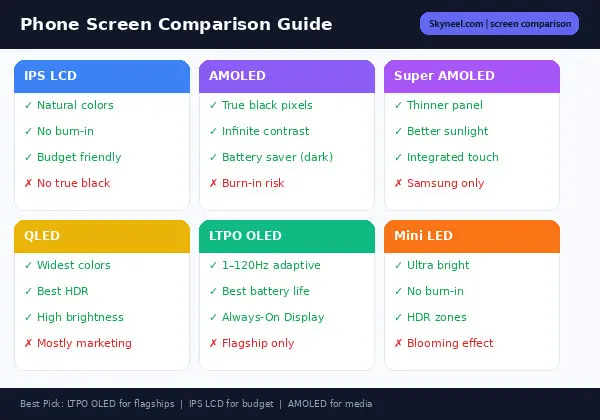
| Feature | IPS LCD | AMOLED | Super AMOLED | QLED | LTPO OLED | Mini LED |
|---|---|---|---|---|---|---|
| Black Level | Dark Gray | True Black | True Black | True Black | True Black | Near Black |
| Contrast Ratio | About 1,000:1 | Infinite | Infinite | Infinite | Infinite | Very High |
| Color Accuracy | Excellent | Very Good | Very Good | Excellent | Excellent | Excellent |
| Battery Efficiency | Moderate | Good | Very Good | Very Good | 🏆 Best | Moderate |
| Sunlight Visibility | Good | Moderate | Very Good | Excellent | Excellent | Excellent |
| Burn-in Risk | ✅ None | ⚠️ Moderate | ⚠️ Moderate | ⚠️ Moderate | ⚠️ Moderate | ✅ None |
| Variable Refresh | ❌ No | ❌ Usually no | ❌ Usually no | ❌ No | ✅ 1-120Hz | Limited |
| Always-On Display | ❌ No | ✅ Yes | ✅ Yes | ✅ Yes | ✅ Best | ❌ No |
| Price Range | Budget to mid-range | Mid to high | Mid to high | Premium | Flagship | Flagship |
AMOLED battery savings apply mainly when using dark mode or dark wallpapers.
Which Phone Screen Type Should You Choose?
| Your Priority | Best Screen Type | Why |
|---|---|---|
| 💰 Tight budget | IPS LCD | Reliable, accurate colors, no burn-in risk |
| 🎬 Movies and media | AMOLED / Super AMOLED | Deep blacks, vivid contrast, strong visuals |
| 🎮 Gaming | AMOLED 120Hz or LTPO | Fast response, smooth frames, low latency |
| 🔋 Battery life | LTPO OLED | Adaptive refresh rate saves power |
| 📸 Photography and color work | QLED or IPS LCD | QLED for HDR, IPS for natural tones |
| 😰 Burn-in concern | IPS LCD or Mini LED | No organic pixels, no OLED burn-in risk |
| ☀️ Outdoor use | Super AMOLED or QLED | High brightness and low reflectivity |
Final Verdict on Phone screen types comparison
When it comes to phone screen types comparison, there is no single winner for everyone. LTPO OLED is the current peak of flagship smartphone display technology because it combines excellent visuals with adaptive battery efficiency. But IPS LCD remains a reliable, worry-free option for budget and mid-range buyers who value color accuracy and durability.
The best advice is to look beyond the marketing label. Always check real display specs such as peak brightness, refresh rate, color gamut, and outdoor brightness ratings. These numbers reveal how a screen performs in daily use.
Happy screen hunting — and may your next phone’s display be everything you dreamed of! 🎉
Phone screen types comparison : Frequently Asked Questions
Which phone screen type has the best battery life?
LTPO OLED is the most battery-efficient display technology. Its variable refresh rate can drop as low as 1Hz during static content, saving power compared to fixed 60Hz or 120Hz screens.
Is AMOLED better than IPS LCD?
It depends on your priorities. AMOLED offers better contrast, true blacks, and better dark-mode efficiency. IPS LCD offers natural colors and no burn-in risk.
Does QLED phone screen prevent burn-in?
No. Most smartphone QLED screens are OLED-based panels with quantum dot enhancements, so they can still carry OLED burn-in risk.
What does LTPO mean in phones?
LTPO stands for Low Temperature Polycrystalline Oxide. It allows the display refresh rate to change dynamically based on screen content.
Which screen type is best for outdoor use?
Super AMOLED and QLED screens usually perform best outdoors because of high peak brightness and low reflectivity. Mini LED displays can also perform very well in bright conditions.
Found this phone screen types comparison helpful? Share it with someone shopping for a new phone, and leave your questions in the comments.👇